
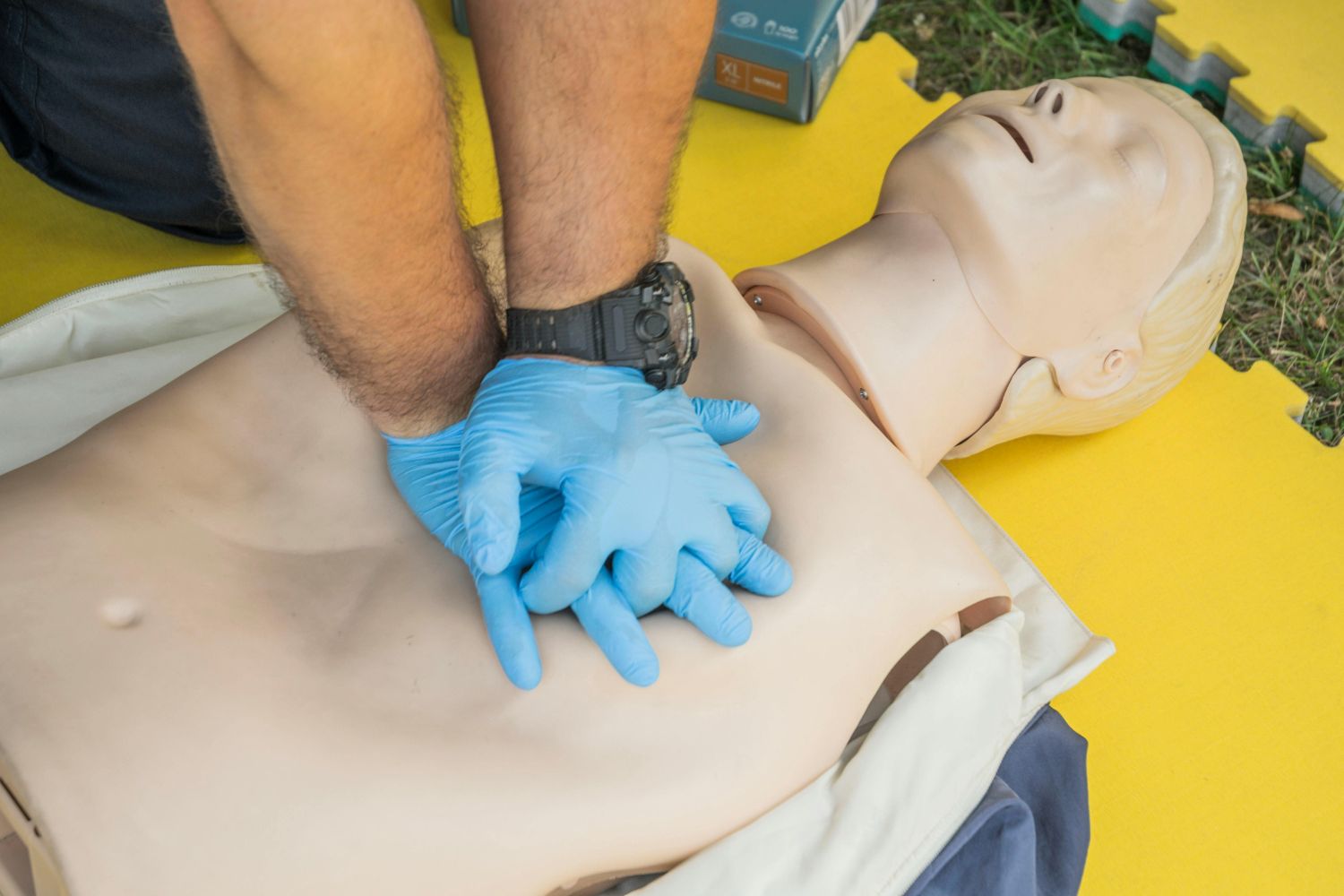

Episode 19: Resuscitation Council UK Guidelines
Podcast Transcript
Resuscitation Council UK Guidelines 2025
Podcast Disclaimer and Introduction
Mark
This podcast provides general information and guidance on first aid treatment.
It is not a substitute for professional medical advice or certified first aid training.
Always seek the advice of a qualified healthcare professional for any medical concerns or before making any decision related to your health or treatment.
In a medical emergency, always call for immediate medical help.
Hi and welcome to episode 19 of First Aid Unboxed, the first aid podcast, which we hope demystifies everyday first aid for you.
My name's Mark Wakeley.
I'm purely the producer and the enabler of the whole thing.
But the main person behind this and the expert in the room,
It's Louise Madeley from Madeley's First Aid Plus.
Hello, Louise.
Louise
Hi, Mark.
Mark
You may notice I'm not very well at the moment.
I'm recovering from a very nasty virus.
So do excuse my slightly strange voice and I will try and say as little as possible in this podcast today.
What Are the Resuscitation Council UK Guidelines?
Mark
Anyway, we're going to talk about the Resuscitation Council UK guidelines.
Louise
Yes.
Mark
Is that right?
I've got that bit right.
Louise
Yeah, 2025.
Mark
Yeah, so every four or five years,
They redo the guidelines and they look at the old guidelines and update everything.
And they have just released these updates, which are now released, but don't come into force until January next year.
If you do want to have a look at yourself, resus.org.uk is the place to go.
And everything we're going to be talking about is also on there as well.
But hopefully we will be able to demystify the whole process for you.
So, first of all, what are the guidelines?
Not necessarily the new guidelines, but what are the resus guidelines and what are they there for to help us with?
Louise
Well, the Resus Council is a governing body well above us that talk about everything to do with resuscitation.
basically.
So they determine what structure we do everything in and how we deliver it.
And from our point of view, as a first aid provider, I now sift through all that information and the courses that I deliver are based on the Resource Council guidelines and what they tell us to do.
Who the Guidelines Are For and How Training Changes
Mark
And who needs to look at these new guidelines?
I mean, are they for the general public?
Are they only for professionals?
What are they for?
Louise
General public can go and have a look at it, by all means.
It's changed this year in that we've now got our own section for first aid solely, which has never happened before.
Mark
And that's for the general public.
Louise
Absolutely, that anybody can go and have a look at.
I've pulled off, say, for adult basic life support, the updates of what was and what is so that you can see what the differences are.
So looking at what the guidelines were compared to what they are now.
So when the recess guidance comes out, all courses are changed a few months later, mainly January.
They came out in October.
So all the awarding bodies will be going back to the drawing board, looking at all these changes and changing their PowerPoints and all their information.
So the courses as from January will not be the same as the course that you will have done if you've done a first aid course in the last.
Louise
What you need to remember though, if you have a certificate at this moment, do not think that you have to get it updated and that you have to do another course because your course is going to be out of date or anything because it's not the updated information.
Your certificate is still valid until it expires.
Key First Aid Changes: Response, CPR and Assessment
Louise
Things like confirming absent or abnormal breathing before calling 999, for example, that has changed.
It's now down to response.
As soon as I say to somebody, the person is unresponsive, actually, that's when I put my phone on speakerphone and make the phone call.
You've got to remember, you are the, what I would term as the FPOS.
The first person on scene, you are the very start of that chain of survival.
So it's all about initial assessment.
We'll call it Dr. ABC, danger, response, airway, breathing.
It's changed slightly, not changed as such, but it's been expanded.
Disability, it's really a prompt for you to look at things like their neurological status.
Exposure is really looking at whether or not they suffer from hypothermia, heatstroke.
Emergency Scenarios, Statistics and Defibrillators
Louise
Recognising that casualties submerged in water is primarily suffering from lack of oxygen.
If a second dose is needed after five minutes, it should be administered into the opposite leg.
It does talk about direct pressure, hemostatic dressings, and packing, and then tourniquets.
The NHS ambulance services attempted resuscitation in around43,000 people in the UK each year.
Median ambulance response times, for example, in England, it's 7.2 minutes.
You literally can't.
It will only go off if somebody's in ventricular fibrillation and needs to be shocked.
Mark
If you want any more information about that from the resus website, it's resus.org.uk.
Louise
Via e-mail, it's enquiries@madeleysfirstaidplus.co.uk, or you can visit my website at madeleysfirstaidplus.co.uk.
Mark
And they can also find out about first aid courses on there as well, can't they?
Louise
Absolutely.
Mark
And book onto courses as well.
Louise
Yeah, there is a link there as well now for WhatsApp, so you can WhatsApp me through the website. It'd be lovely to hear from you.
Mark
That is fantastic. That's all we've got time for, really, tobe honest, this week. We'll be back next month with another First Aid Unboxed.So until then, thanks very much for listening. As I said, if you want to get intouch with Louise, you can do through the website and the e-mail address. Andwe will speak to you very soon. Thank you very much, Louise.
Louise
My pleasure. Thank you.
Mark
This is a 1386 audio production.
Ready to train to the latest guidelines?
All our courses are updated to reflect the 2025 Resuscitation Council UK guidelines. Book now: